
Free E-E-A-T checker
Does your post show who wrote it?
Enter a blog post URL and this checker looks for the trust signals behind E-E-A-T: a visible byline, an author page, Person schema, publish and update dates, About and Contact pages, and links to authoritative sources. Each result explains why it matters and how to fix it.
What this checker looks at
- 01Visible author bylineA name on the page, near the post.
- 02Author pageThe byline links to a page that loads.
- 03Person schemaAuthor markup with name, jobTitle and sameAs.
- 04Published and updated datesOn the page or in the article schema.
- 05CitationsLinks to government, university, standards and major research sources.
- 06About pageLinked from the post or homepage, and reachable.
- 07Contact pageLinked from the post or homepage, and reachable.
Every check is a fixed rule run on your live pages. Results can differ from what a crawler sees if your site blocks automated visits.
Put a real author on every post
- When Draftly publishes to WordPress, it can add an author byline with the writer's name, title, short bio and a link to their profile.
- Posts link one or two real sources and your own pages.
- Draftly learns your brand's voice from your website, so posts read like the people who run the business.
Draftly is for US businesses and writes blog posts only. See plans and prices.
More free tools
- Free toolAI visibility checkerCheck if ChatGPT, Claude, Perplexity and Google can crawl and cite your website.
- Free toolBlog post SEO checkerPaste a blog post URL and get a free SEO checklist: title, meta description, headings, word count, alt text, links, schema, canonical and broken links..
- Free toolContent refresh checkerFind blog posts that need a content refresh.
Frequently asked questions
What is E-E-A-T?
Experience, Expertise, Authoritativeness and Trust. It comes from Google's Search Quality Rater Guidelines and describes what makes content trustworthy. Google says it isn't a ranking factor by itself. The signals behind it help readers, Google and AI tools decide who to trust.
How do I show E-E-A-T on a blog post?
Name the author, link to an author page with their real experience, date the post, cite your sources, and make it easy to see who runs the site through About and Contact pages.
What counts as an authoritative source?
This checker counts government, university, standards bodies and major research or news sources, such as .gov and .edu sites, Google's own documentation, Wikipedia and Reuters. A good industry source can be authoritative too, so treat a warning as a prompt to look.
Why is my byline marked as missing when I can see it?
The checker looks for markup that identifies an author, such as a class or rel="author". If your theme shows the name as plain text, add rel="author" to the link or an author class to the element.
Is the E-E-A-T checker free?
Yes, with no sign-up. We don't store the URLs you enter or the results, and no AI model reads your pages.
Updated October 2026 by Preston Vawdrey at Draftly.
Keep reading
 GuideSEO copywriting rules we check on every postStructure, voice and call-to-action rules, with before and after examples.
 GuideThe AI copywriter for small-business blogsHow Draftly goes from your URL to a published post in your brand voice.
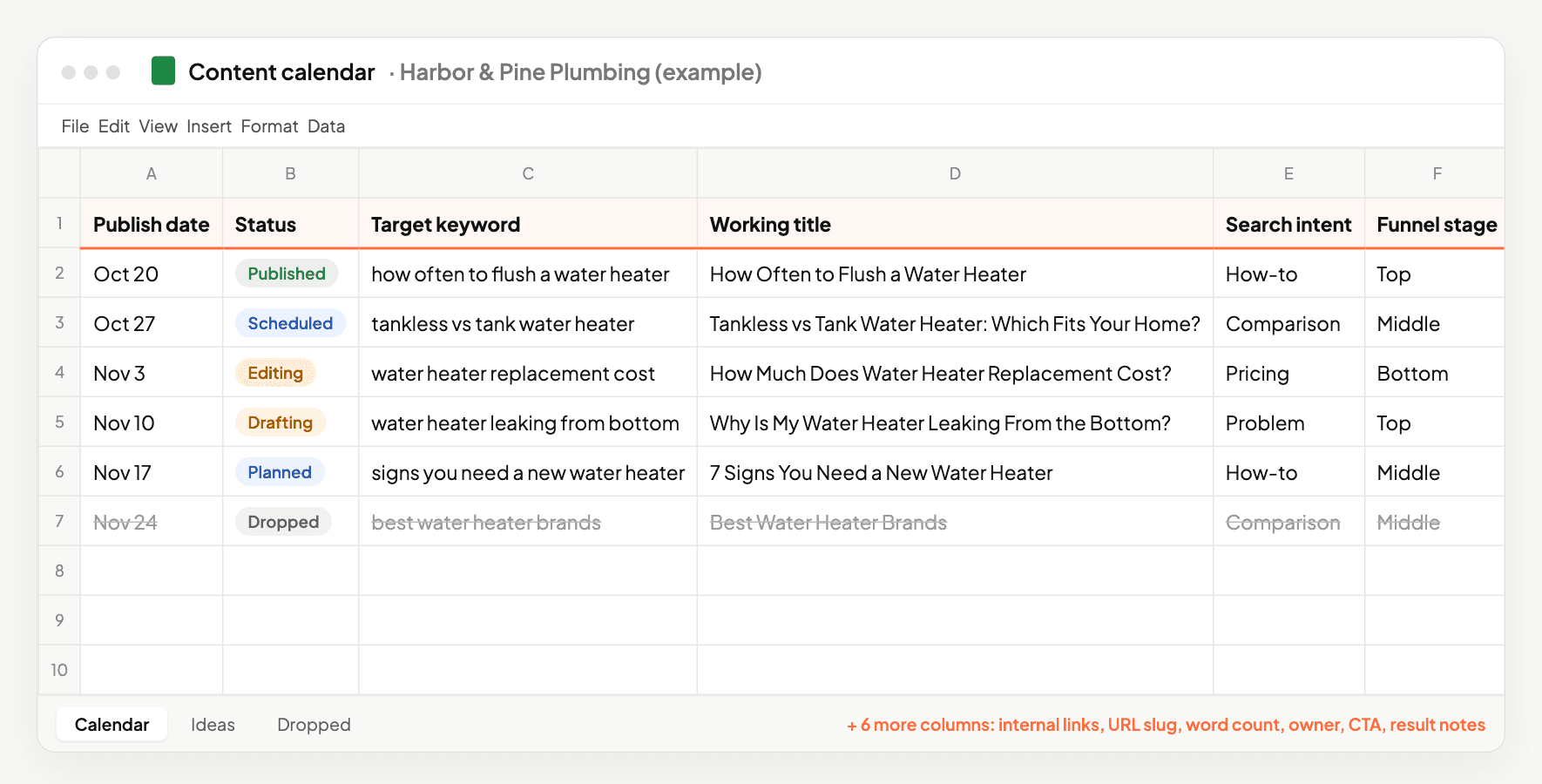 Blog postHow to Create a Content Calendar From a Blank Spreadsheet: 12 Columns That Actually MatterHow to create a content calendar in Google Sheets: the 12 columns worth keeping, how to map keywords to dates, a…